
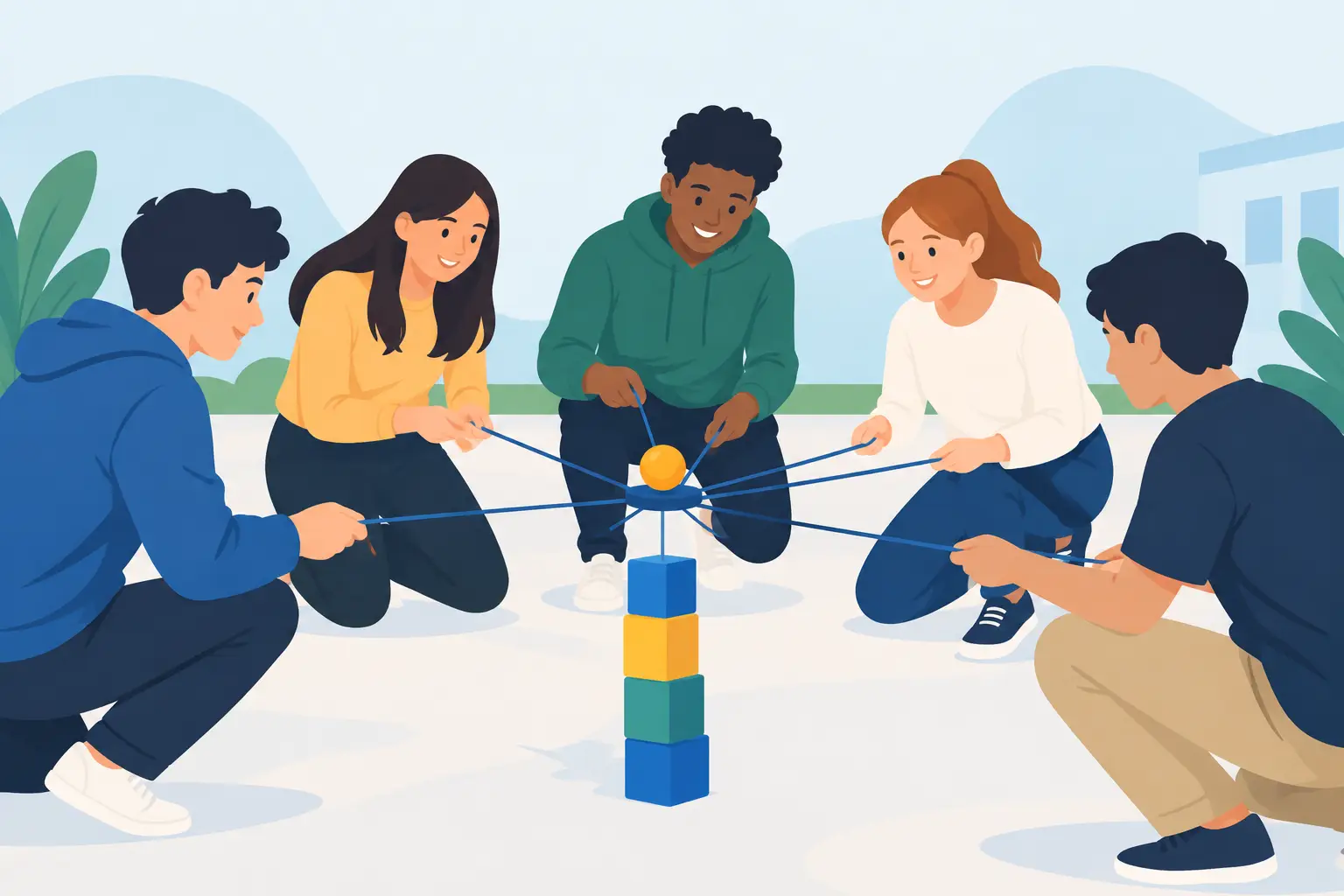
A student who feels seen is more likely to speak up, try again, and help someone else succeed. That is why team building games students can participate in with confidence are more than a break from instruction. When they are thoughtfully led, they create low-stakes moments for young people to practice communication, solve problems, and recognize the value each person brings to a group.
For schools, youth programs, teams, and community partners, the goal is not simply to fill time with activities. It is to build the habits that support academic growth, athletic development, healthy relationships, and future leadership. The best games give students a shared challenge, a clear role, and a reason to listen to one another.
What strong team building games give students
A meaningful activity should make participation feel possible for more than the loudest or most athletic students. Some young people lead by organizing ideas, noticing details, encouraging peers, or staying calm under pressure. A well-designed game makes room for those strengths.
Team building also works best when it connects to a larger purpose. A relay can teach perseverance. A problem-solving task can reveal how assumptions affect a group. A conversation exercise can help students learn the names, interests, and goals of classmates they might otherwise overlook. These lessons matter in classrooms, on courts and fields, and later in workplaces and communities.
Before beginning, establish a few simple expectations: everyone gets a chance to contribute, mistakes are part of learning, and competition never outweighs respect. Then choose activities based on the age of the group, available space, and the relationships you want to strengthen.
12 team building games students can lead and enjoy
1. Human Knot
Students stand in a circle, reach across to take two different hands, then work together to untangle themselves without letting go. The game is energetic, but its real value is communication. Students quickly learn that pulling ahead alone can make the challenge harder for everyone.
This works well with groups of eight to 12. Offer an alternative role, such as observer or coach, for students who prefer not to participate in close physical contact.
2. Silent Line-Up
Ask students to arrange themselves in order by birthday month, shoe size, or distance from school – without speaking. They must use gestures, eye contact, and patience to complete the task.
This is a useful early activity because it shows how much communication happens without words. For a more accessible version, use categories students can indicate easily, such as favorite season or number of siblings.
3. Build the Tallest Tower
Give small teams limited materials such as paper, tape, straws, and string. Their task is to build the tallest free-standing tower within 15 minutes. Measure both height and stability.
The activity rewards planning, testing, and adapting. Rather than praising only the winning tower, ask each team what changed after its first attempt. That reflection helps students see revision as a strength, not a failure.
4. Community Map
Place a large sheet of paper on a table or wall and invite students to create a map of the places, people, and resources that help young people thrive. They might include a library, a coach, a grandparent, a local business, a counselor, or a community center.
Unlike a fast-paced game, this activity builds belonging through shared perspective. It also opens a productive conversation about where students need more support and how adults can help connect them to opportunity.
5. Minefield Guide
Set out cones, paper cups, or other soft markers across an open area. One student closes their eyes or wears a blindfold while a partner guides them through the course using only verbal directions.
Trust is central here, so students should always have the option to keep their eyes open and simply look downward. Use clear boundaries, remove tripping hazards, and keep the course slow. The lesson is not about fear. It is about giving precise instructions and honoring responsibility for another person’s safety.
6. The Marshmallow Challenge
Teams receive spaghetti, tape, string, and one marshmallow. They have a limited time to build the tallest structure that can hold the marshmallow at the top.
This challenge often exposes a common group habit: spending too long debating the perfect plan. Students learn that action, feedback, and adjustment usually produce better results than waiting for certainty. It is especially effective before a project that requires design thinking or collaboration.
7. Sports Strategy Switch
Create a short relay, passing drill, or movement challenge. Give each team two minutes to plan, then ask them to swap strategies with another team and carry out the new plan.
The switch encourages students to respect different approaches rather than assume their own is best. It is a natural fit for athletic programs, but it can also help classroom groups understand flexibility, leadership, and shared ownership.
8. Story Circle
One student begins a story with a single sentence. Each person adds one sentence, with the goal of creating a story in which every voice changes the direction of the plot.
The rules are simple: build on what came before, do not erase someone else’s idea, and make room for quieter voices. Students practice listening closely while discovering how creativity improves when it is shared.
9. Escape the Envelope
Prepare envelopes with age-appropriate clues, simple puzzles, and a final code word. Each clue should require a different strength: reading, visual observation, basic math, pattern recognition, or memory.
This activity is powerful because no one skill solves the whole challenge. Make sure each team member receives a clue or role so students can experience the difference between being present and being needed.
10. Gratitude Toss
Students stand in a circle and gently toss a soft ball. Before throwing it, each student names something they appreciate about a teammate, classmate, mentor, or community member.
Keep the prompts specific. “You helped me understand the directions” carries more meaning than a general compliment. For groups still getting to know one another, students can name a quality they value in a good teammate instead.
11. Budget for Impact
Give teams a fictional budget and ask them to design a one-day event that supports students in their community. They may choose how to spend funds on food, transportation, supplies, mentors, athletics, or career speakers.
The discussion that follows is the real activity. What did teams prioritize? What did they have to leave out? Students gain a practical view of how community programs require both vision and thoughtful choices.
12. Pass the Leadership Role
Give teams a simple task, such as organizing materials, completing a puzzle, or planning a short presentation. Every two minutes, a new person becomes the facilitator. Their job is to invite input, track time, and make sure the group stays respectful.
Students often discover that leadership is not the same as taking over. It can mean asking a useful question, making space for another idea, or helping the group move forward when energy drops.
Make the lesson last beyond the game
The debrief is where a fun activity becomes a growth opportunity. Keep it brief, but do not skip it. Ask students what helped their group work well, where communication broke down, and what they would do differently next time. Questions should focus on behaviors rather than personalities, so students leave with skills they can use again.
It also helps to rotate roles across activities. A student who usually leads the conversation can practice listening. A student who rarely volunteers can take charge of materials or present the team’s idea. Growth happens when young people are trusted with meaningful chances to stretch.
Not every game will fit every group. Highly competitive activities can energize some students while discouraging others. Physical challenges may need adaptations for mobility, sensory comfort, or safety. The strongest facilitators pay attention, offer choices, and adjust without making anyone feel singled out.
A shared investment in future leaders
Young people build confidence when adults create environments where collaboration is expected, encouragement is visible, and every contribution matters. Families, educators, coaches, mentors, and community partners each have a role in making those environments possible.
At Combs Enterprises, athletics, education, mentorship, and career exposure work together because students deserve connected opportunities, not isolated moments of support. A simple team challenge can be one starting point. What matters most is what students learn to carry forward: how to trust, contribute, lead, and make room for someone else to rise.
Leave a Reply